
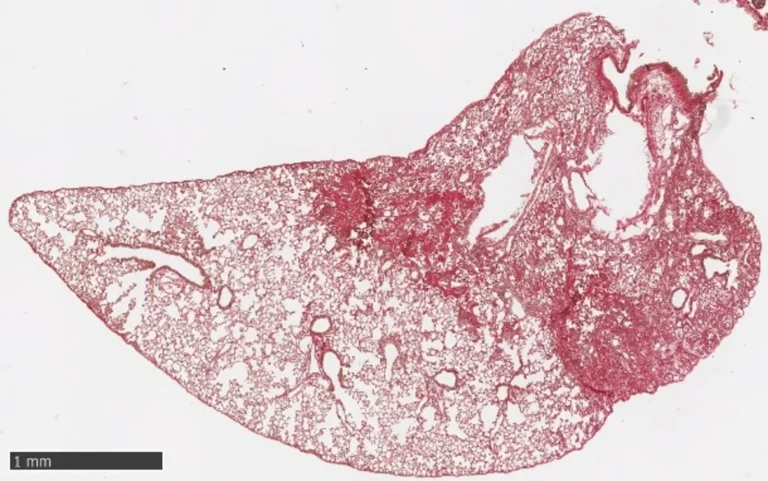
Researchers affiliated with the RespirERA Institute and a Pfizer team (Pfizer Rare Disease) tested a soluble decoy receptor called sFGFR3-Fc. It captures certain signals that promote the formation of scar tissue in the lungs. The first results, obtained in human cells and mice, are encouraging but remain preclinical.
When lung repair becomes excessive
When a lung is damaged, different cells help repair the tissue. In idiopathic pulmonary fibrosis, or IPF, this repair mechanism becomes disrupted. Too much scar tissue gradually forms, making the lungs stiffer and impairing their function.
Cells called fibroblasts play a central role in this process. Under normal conditions, they produce the components needed to repair tissue. In fibrosis, they become overactive and produce too much fibrous material.
This material, known as the extracellular matrix, accumulates around the cells. Over time, it prevents the lung from retaining its flexibility. Current treatments can slow the progression of the disease, but they cannot remove scar tissue that has already formed.
Intercepting the signals that activate fibroblasts
Cells constantly exchange chemical signals to function. Some of these signals are carried by fibroblast growth factors, or FGFs. Depending on the type of cell and the biological context, these molecules can either promote or limit fibrosis.
In this study, the researchers focused on three of them: FGF1, FGF2 and FGF9. In the context studied, these molecules can activate mechanisms that cause fibroblasts to multiply and produce more extracellular matrix.
The team therefore evaluated a protein called sFGFR3-Fc. It is a modified soluble form of the FGFR3 receptor, which is normally found on the surface of cells.
This soluble receptor acts as a decoy. It captures FGF1, FGF2 and FGF9 before they can reach the cells and transmit their signals. This is why scientists describe it as a “decoy receptor”.
The approach aims to neutralise specific signals without blocking the entire FGFR receptor family, which also performs important functions in the body.
Tests on human lung cells
The researchers first studied lung fibroblasts obtained from healthy donors and people with idiopathic pulmonary fibrosis.
In the laboratory, FGF2 caused these cells to multiply and produce several components associated with fibrosis. Adding sFGFR3-Fc reduced these responses.
The sFGFR3-Fc decoy receptor also limited some of the effects of TGF-β. This molecule carries signals that play an important role in fibroblast activation and scar tissue formation.
The scientists then used a method called single-cell transcriptomics to study which genes were active in each cell. This technique reveals differences between cells that may appear to belong to the same group.
The analyses showed that fibroblasts from lungs affected by IPF did not all respond in the same way. Despite this diversity, sFGFR3-Fc reduced the activity of several genes associated with FGF2 and TGF-β signalling in certain fibroblast populations involved in fibrosis.
Reduced fibrosis in mouse models
The researchers then tested sFGFR3-Fc in mice. To reproduce some of the mechanisms involved in pulmonary fibrosis, they used bleomycin, a substance that causes lung injury and scar tissue formation.
Two situations were studied. In the first, the mice received a single administration of bleomycin. In the second, repeated administrations were used to produce more severe fibrosis.
The researchers evaluated sFGFR3-Fc as both a preventive strategy and a therapeutic approach after fibrosis had been triggered. In both cases, they observed fewer extracellular matrix deposits in the lungs. They also recorded a recovery in the animals’ body weight and an improvement in lung function.
These results show that sFGFR3-Fc acts on several mechanisms associated with fibrosis in the models studied. They also suggest that the FGF and TGF-β pathways, two communication systems used by cells, are closely connected in the development of the disease.
Research conducted with Pfizer
This work was carried out in collaboration with a Pfizer team (Pfizer Rare Disease), building on Célia Scribe’s doctoral research. Her PhD was completed in Bernard Mari and Georges Vassaux’s team through France’s CIFRE scheme, which supports doctoral research conducted jointly by an academic laboratory and a company.
Several authors of the publication are affiliated with the Institute of Molecular and Cellular Pharmacology (IPMC), Université Côte d’Azur, CNRS, Inserm and the RespirERA Institute.
The study therefore combines several levels of research: experiments on human cells, single-cell analysis of gene activity and evaluations in different animal models.
A research avenue, not yet a treatment
The results support continued research into sFGFR3-Fc for idiopathic pulmonary fibrosis. This approach could make it possible to target more precisely certain signals that promote scar tissue formation.
However, this remains preclinical research. sFGFR3-Fc was not administered to patients in this study. The effects observed in laboratory-grown cells and mice therefore do not demonstrate that it would be effective in humans.
Further research will be needed to understand its mechanism more fully, assess its safety and determine whether this approach could eventually be evaluated in clinical trials.
 Français
  English (UK)