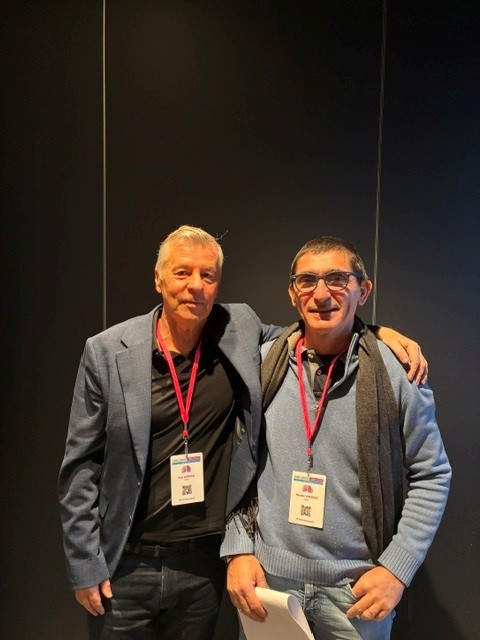
On 5–6 November 2026, Professor Paul Hofman, Director of the RespirERA Institute, took part in the 8th edition of Lung Cancer a New Vision in Lyon, France. As a scientific committee member and speaker, he contributed to discussions on current practices and future approaches to lung cancer care.
Bringing together different perspectives on lung cancer
Organised by Bristol Myers Squibb, the meeting focused on current and future practices in thoracic oncology (the medical specialty dedicated to cancers of the chest, including lung cancer). The programme combined scientific updates, real-world data (information collected through everyday patient care) and discussions of clinical cases.
Several specialties were represented, including respiratory oncology, thoracic surgery and pathology (the study of tissues and cells to characterise a disease). This multidisciplinary approach provided an opportunity to discuss scientific knowledge alongside questions arising in clinical practice.
Discussing future approaches to care
Professor Paul Hofman co-chaired a session with Professor Michaël Duruisseaux on future approaches to treating metastatic non-small cell lung cancer (lung cancer that has spread to other parts of the body).
Presentations covered new treatment options, therapeutic targets (features of cancer cells that treatments aim to act on) and organisational challenges for pathologists and molecular biologists. The session explored both treatment prospects and the testing needed to characterise tumours.
Examining pathology and surgery reports
On 6 November, Professor Hofman also spoke alongside Professor Nicolas Vénissac during the session on localised non-small cell lung cancer. Their joint presentation, “Pathology and surgery reports: spot the error!”, examined these documents from the perspectives of a pathologist and a surgeon.
Pathology reports describe the findings from the analysis of tissue samples. Surgical reports document the operation performed. Considering these reports together helps connect the information they contain and build a clearer understanding of a patient’s case.
Through his role on the scientific committee, his contribution as a session co-chair and this joint presentation, Professor Hofman brought a pathologist’s perspective to discussions between the specialties involved in lung cancer care.
 Français
 English (UK)