
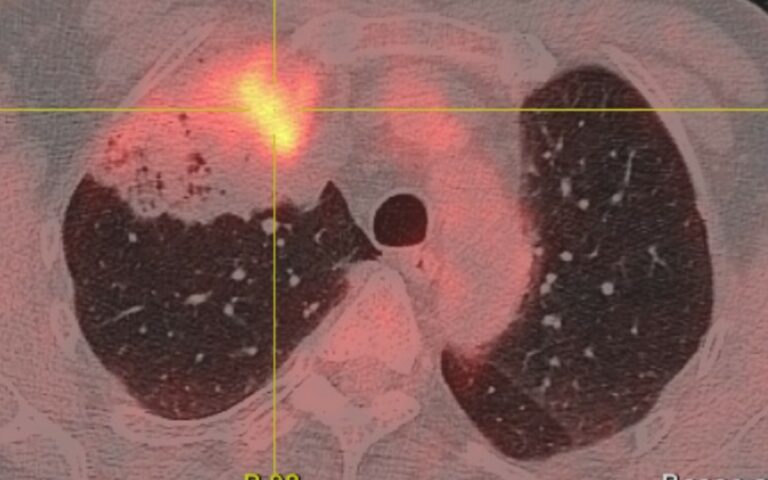
Lung cancer is currently the deadliest cancer in France, causing nearly 30,000 deaths each year. In response to this major respiratory health challenge, the Minister of Health, Stéphanie Rist, has announced the rollout of a nationwide, population-based screening program by 2030.
This marks a major step forward for prevention and early diagnosis — with IHU RespirERA playing a central role.
Detecting earlier to save lives
The future national program is built on a simple principle: detect lung tumors at a very early stage, before symptoms appear.
Screening relies on low-dose chest CT scans, which can identify small pulmonary nodules that are often still operable. The earlier lung cancer is diagnosed, the significantly higher the chances of survival.
The experimental IMPULSION program, launched in 2025, serves as the foundation for this future nationwide rollout. It currently targets:
- People over the age of 50
- Current smokers
- Former smokers who quit less than 15 years ago
In the future, eligibility criteria may be expanded, particularly to individuals exposed to occupational risks (such as firefighters) and to women, among whom early-stage cases are increasing.
IHU RespirERA at the heart of the national strategy
Nice has become a strategic hub for lung cancer screening in France.
Under the leadership of Professor Paul Hofman, IHU RespirERA coordinates the national database for the IMPULSION program. This database centralizes:
- Chest CT scan images
- Patients’ clinical data
- Information collected from several major French cities (including Paris, Lyon, and Amiens)
This centralization is essential to enhance screening quality, refine patient selection criteria, and accelerate research in respiratory health.
Specific expertise in high-risk patients
The Nice-based teams, particularly the pulmonology department of Nice University Hospital led by Professor Marquette, Director of Medical Research at IHU RespirERA, have developed strong expertise in patients with Chronic Obstructive Pulmonary Disease (COPD).
These patients have a fivefold higher risk of developing lung cancer compared to the general population. Accurately identifying these high-risk profiles is therefore a key strategic priority to ensure more effective and targeted screening.
Artificial intelligence and biomarkers: a major innovation
One of the challenges of large-scale screening is preventing imaging services from becoming overwhelmed.
To address this, IHU RespirERA is developing an innovative approach that combines:
- Artificial intelligence applied to radiological imaging
- Blood-based biomarkers (biological signatures)
The objective is to better identify the highest-risk patients before referring them for CT scans, thereby optimizing resources and improving the precision of early diagnosis.
This strategy is fully aligned with the institute’s medical and scientific priorities, particularly in the areas of complex data management and AI applied to respiratory health.
The key role of general practitioners
Unlike other screening programs, there will be no automatic invitations.
General practitioners will play a central role in the system. Using a dedicated tool, they will identify eligible patients and refer them for low-dose chest CT scans.
This organization is designed to integrate screening into routine care pathways, ensuring close proximity to patients.
Preventing to transform respiratory health
The nationwide implementation of lung cancer screening represents a decisive milestone for respiratory health in France.
By combining clinical expertise, artificial intelligence, data centralization, and biological innovation, IHU RespirERA is actively contributing to the development of an ambitious national strategy.
The goal is clear: reduce mortality, improve patients’ quality of life, and sustainably transform the prevention of respiratory diseases.
