Long considered sterile, the lungs are now revealing a very different reality. Recent scientific advances are shedding light on an active microbial ecosystem whose role could be crucial in the progression of serious respiratory diseases such as pulmonary fibrosis.
The lungs have their own living world
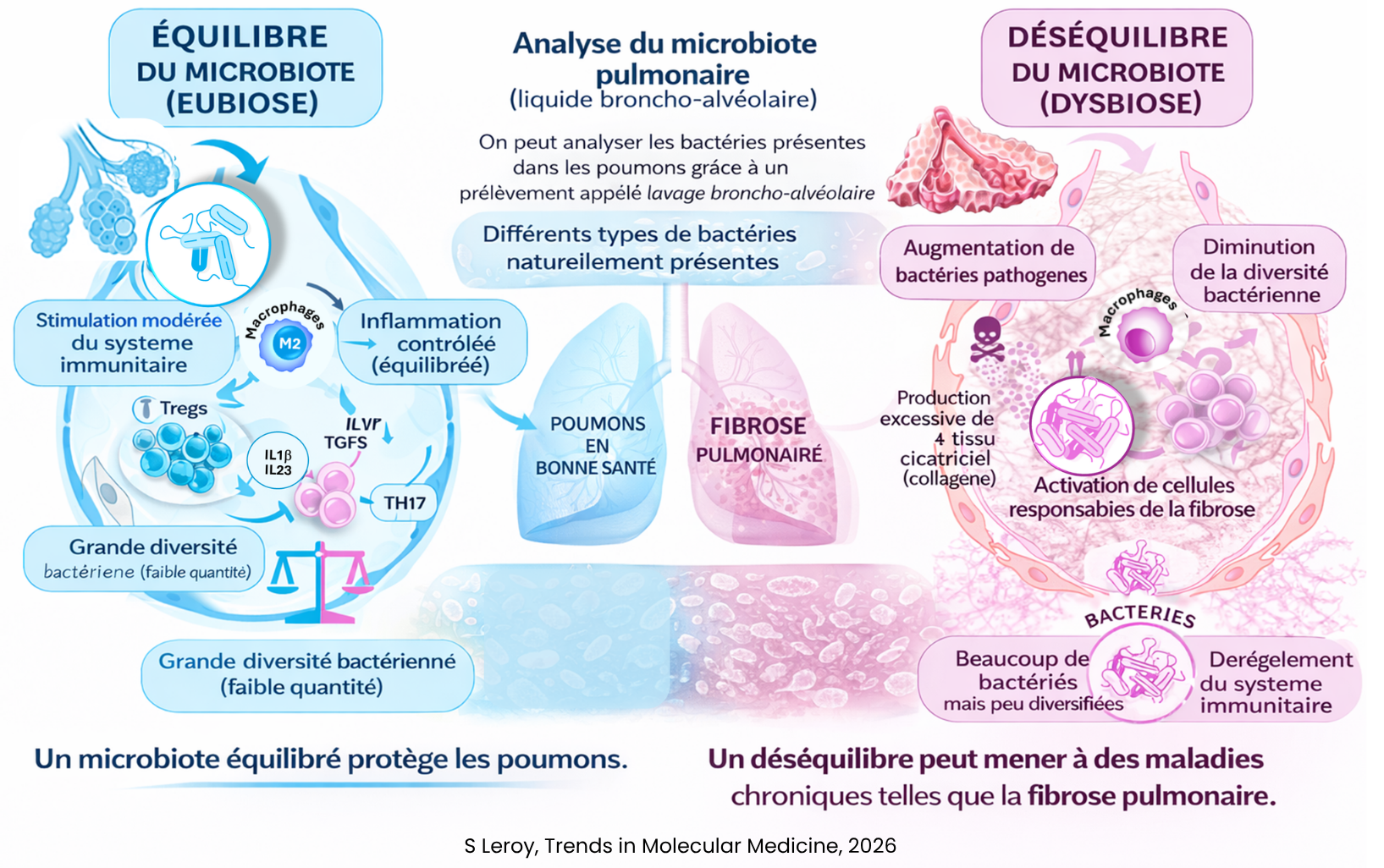
For a long time, the lungs were thought to be sterile, a territory completely devoid of microorganisms. Research conducted at IHU RespirERA (Sylvie Leroy et al., TMM 2026) and worldwide is now challenging this belief. In reality, our lungs host a discreet yet very real microbial ecosystem made up of bacteria, viruses, and fungi: the lung microbiome. Understanding this ecosystem could profoundly change the way we manage severe respiratory diseases such as idiopathic pulmonary fibrosis, a condition for which prognosis and treatment options remain limited.
An invisible, fragile, and essential balance
In healthy lungs, thousands of bacteria, viruses, and fungi coexist silently. Far from being mere intruders, these microorganisms play an active role: they help “train” the immune system and enable it to respond appropriately to infections.
This ecosystem can be compared to an island in constant evolution, where microorganisms continuously arrive through inhaled air, while the body’s natural defenses work to maintain balance. As long as this balance is preserved, the lungs function properly.
When balance is disrupted: dysbiosis
In certain diseases, particularly pulmonary fibrosis, this balance is disturbed. Potentially harmful bacteria begin to proliferate, with their numbers increasing by 10 to 100 times compared to healthy lungs. This imbalance, known as dysbiosis, sustains chronic inflammation and accelerates lung damage.
The underlying mechanism forms a vicious cycle: damaged lungs attempt to repair themselves, but this repair process becomes excessive. It leads to the formation of scar tissue, a hallmark of fibrosis, which progressively impairs breathing.
What the microbiome reveals about the disease
The quantity and nature of bacteria present in the lungs provide valuable insights for clinicians. A high bacterial load is associated with an increased risk of disease progression and mortality. Certain specific bacterial species also appear to be linked to more severe forms of the disease.
Analyzing the lung microbiome could therefore help better predict disease progression and enable more tailored treatment strategies for each patient.
The lungs and their microbiome are not isolated
The lungs are in constant communication with other organs. Bacteria from the oral cavity can migrate to the lungs, particularly in cases of reflux or poor oral hygiene. At the other end of the body, a healthy gut microbiome contributes to limiting lung inflammation.
This connection, known as the lung–gut–oral axis, opens up new therapeutic perspectives, including approaches based on diet and lifestyle.
Towards more targeted and personalized treatments
Conventional antibiotics are not always the right solution. By indiscriminately eliminating bacteria, they may worsen the imbalance rather than correct it.
Teams at IHU RespirERA are exploring more precise strategies, aiming to target specific bacteria, modulate their effects, or restore a balanced microbiome.
The goal is both ambitious and practical: to provide each patient with a treatment tailored to their own microbial ecosystem.
A new era for respiratory medicine
The lung microbiome is emerging as a key player in respiratory health. Its study represents a major turning point in understanding complex diseases such as pulmonary fibrosis.
At IHU RespirERA, this research lies at the heart of our mission: transforming scientific knowledge into tangible hope for patients.