
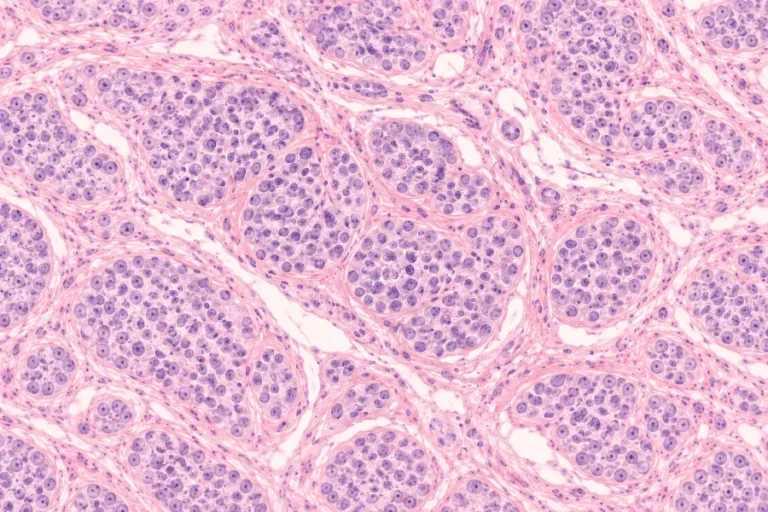
An international study involving Professor Paul Hofman, Director of the RespirERA Institute, and Dr Véronique Hofman, a thoracic pathologist at the institute, proposes recognizing a category of grade 3 lung carcinoids. Published on September 25, 2026, in the Journal of Thoracic Oncology, this research aims to better characterize certain rare tumors.
Tumors that challenge the current classification
Lung carcinoids belong to the family of neuroendocrine tumors (tumors arising from cells that can produce hormones in response to nerve signals). The World Health Organization classification distinguishes between typical carcinoids, classified as grade 1, and atypical carcinoids, classified as grade 2.
Some rare forms retain the appearance of a carcinoid while showing higher rates of cell division. Their classification as large cell neuroendocrine carcinomas (another category of lung cancer) is the subject of scientific debate.
A study conducted across six countries
The Pathology Committee of the IASLC, the International Association for the Study of Lung Cancer, brought together 28 cases from nine institutions across six countries.
The thoracic pathologists compared tissue appearance, biological markers and the available patient data. The findings reveal characteristics similar to those of carcinoids, despite high rates of cell division. In this series, follow-up data also showed less favorable outcomes than in the typical and atypical carcinoid groups used for comparison.
Recognizing a grade 3 category
The authors propose classifying these forms as grade 3 lung carcinoids to better align their diagnosis with their biological characteristics.
Grade (an assessment of tumor cell characteristics and aggressiveness) differs from stage, which describes the extent of the disease within the body.
This proposal contributes to the debate on the classification of these rare tumors. It suggests a new category based on the microscopic appearance of these very rare tumors, which could soon be proposed for inclusion in the WHO’s 2027 histological classification.
 Français
  English (UK)