
A research team from IHU RespirERA, working in collaboration with the company BIODENA, has highlighted the promising role of the blood biomarker hPG80, a circulating protein produced by certain cancer cells that can indicate the presence of malignant tumors, in better identifying lung cancer risk, particularly among former smokers.
Lung cancer: a major public health issue
Lung cancer is the deadliest cancer in France and worldwide. Smoking is the leading risk factor: even after quitting, many former smokers remain at high risk of developing lung cancer for many years.
Today, screening relies on low-dose chest computed tomography (LD-CT), a scan used to detect lung abnormalities. While effective, this exam sometimes lacks specificity and sensitivity, leading to a significant number of false positives and false negatives that require additional investigations.
hPG80: a biological signal influenced by smoking
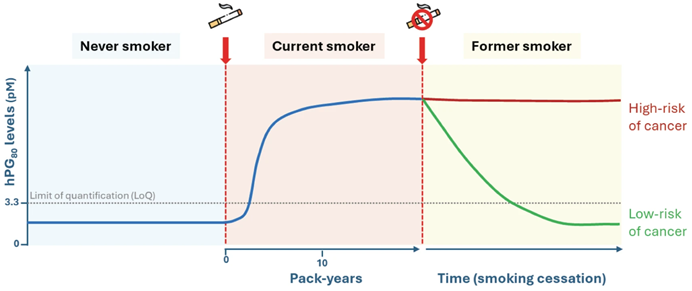
Led by Drs. Véronique Hofman, Charles-Hugo Marquette, Jean-Philippe Berthet, Jacques Boutros, Marius Ilié and Paul Hofman at IHU RespirERA, in close collaboration with BIODENA, the study shows that blood levels of hPG80 increase with smoking but gradually decrease after cessation.
The results show that:
- In active smokers, hPG80 levels are consistently high, but these values do not allow researchers to distinguish the effect of smoking from the possible presence of lung cancer.
- In former smokers, hPG80 levels normally return to a low baseline after quitting.
- When hPG80 levels remain elevated after smoking cessation, this may indicate a persistent risk of developing lung cancer.
- hPG80 therefore appears to be a particularly relevant marker for identifying former smokers at high risk of developing lung cancer—something that current tools cannot reliably achieve.
A concrete step forward for prevention and screening
hPG80 could enhance lung cancer screening strategies by providing objective biological information on the individual risk of former smokers.
In practice, this biomarker could:
- Help better identify which former smokers should benefit from closer monitoring.
- Improve screening specificity when used alongside LD-CT.
- Serve as a measurable indicator of improvement after smoking cessation, offering motivational support for individuals aiming to quit permanently.
- Detect persistent risk in former smokers who show no apparent respiratory disease on imaging.
These results support the need for further multicenter prospective validation before hPG80 can be integrated into screening programs.
