
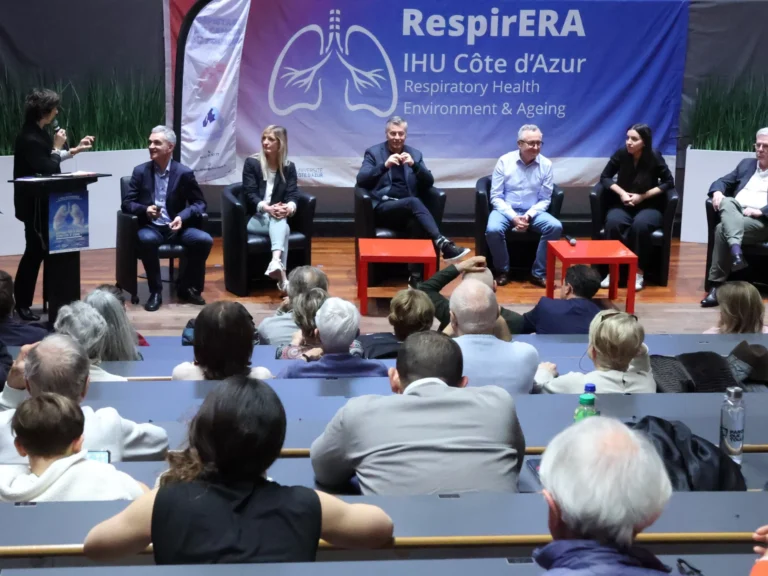
On Saturday, February 28, 2026, IHU RespirERA met with the people of Nice at the Saint-Jean d’Angély Campus for a public debate dedicated to respiratory health. Experts shared key insights on early screening, artificial intelligence, research, environmental factors, and everyday prevention.
Why respiratory health is a major issue in Nice
Nice and its surrounding region are particularly exposed to factors that can weaken respiratory health. Climate change is intensifying certain phenomena, pollen levels are especially high in the area, and summer often brings pollution peaks linked to traffic, with strong sunshine contributing to the formation of ozone, an irritating gas. The population also includes more vulnerable groups, such as newborns and older adults, which further highlights the importance of prevention and awareness efforts. In this context, IHU RespirERA aims to advance respiratory health by combining patient care, high-level research, and digital innovation, in close alignment with the needs of the local community.
Detecting earlier to save lives
During the debate, experts emphasized that lung cancer is often diagnosed at a late stage, partly because it can remain painless for a long time. To reverse this trend, IHU RespirERA is implementing early screening strategies, notably through the IMPULSION program, a pilot project in the PACA region based on very low-dose CT scanning. A key message was the importance of making screening more accessible by reaching out directly to people, for example in markets, shopping centers, or even within companies, and by offering rapid appointments within less than seven days. Speakers also presented research on blood biomarkers that could help detect cancer at a very early stage, sometimes even before it becomes visible on imaging, and improve risk assessment among non-smokers, who account for a proportion of lung cancer cases. In addition, it was noted that a CT scan can also identify other health conditions, such as COPD, certain cardiovascular diseases, or osteoporosis, paving the way for a more comprehensive screening approach.
Artificial intelligence and the digital twin: tools to support physicians
Artificial intelligence was presented as a valuable support tool for healthcare professionals, without any intention of replacing them. Experts explained that AI can analyze medical images consistently and identify very small elements on a scan, such as a nodule the size of a grain of rice among thousands of anatomical structures. The discussion also highlighted the concept of the digital twin, which involves creating a personalized computer model of a patient in order to simulate treatment scenarios, plan specific medical procedures, or anticipate how a patient might respond to a therapy before it is administered. This approach is part of a broader international collaboration, notably with Memorial Sloan Kettering in New York, enabling comparisons between local data and global databases and contributing to the development of more precise, personalized medicine.
Cutting-edge research to understand the lung before symptoms appear
IHU RespirERA’s teams in Nice presented advances in fundamental research related to mapping lung cells, in connection with the Human Cell Atlas initiative. The goal is to better understand the identity and function of lung cells in order to clarify how certain diseases develop and progress. Speakers referred to the discovery of rare cell types and “diseased” cellular profiles associated with conditions such as asthma or COPD, which could potentially be identified at a very early stage, sometimes even before symptoms appear. They also explained the principle of tissue twins, which involves growing patients’ cells in the laboratory to test therapeutic strategies and move toward more personalized treatment approaches.
Monitoring viruses and variants through wastewater analysis
Among the key topics discussed, IHU RespirERA presented epidemiological surveillance through wastewater analysis. Using genetic sequencing, this method makes it possible to monitor the circulation of viruses such as influenza or COVID-19 at the city level and detect very early warning signals. Experts explained that this approach can identify the arrival or presence of a variant with very high sensitivity, helping anticipate epidemic waves and adapt public health measures accordingly.
Everyday prevention: air quality, nutrition, and addictions
Prevention was central to the discussions, with practical guidance shared with the audience. Experts recalled that air pollution is a significant risk factor and that in Nice, summer ozone can irritate the respiratory tract, encouraging people to adapt their habits during heatwaves and pollution peaks. They recommended airing homes in the morning and evening while avoiding heavy traffic periods, and limiting intense physical activity during high heat and pollution episodes. The link between nutrition, the microbiome, and lung immunity was also addressed, with advice to reduce ultra-processed foods, sugars, and certain processed meats, and to favor a more plant-based diet and whole foods. A strong message also concerned addictions, with a reminder of the impact of tobacco, the need for vigilance regarding vaping among young people, and the severe respiratory risks associated with certain inhaled substances. Experts stressed that addiction is a chronic condition often linked to psychological factors, and that nicotine may actually maintain anxiety rather than relieve it.
Early prevention and precision medicine in the service of the people of Nice
This meeting helped clarify how research, technological innovation, and prevention can work together to transform respiratory health. IHU RespirERA reaffirmed its strategy: act early, starting in childhood, promote earlier screening, and develop precision medicine supported by artificial intelligence. The discussions also highlighted the hope of a future dedicated “totem building” in Nice, which would further strengthen the institute’s impact and commitment to improving respiratory health for the local population.
