
Lung cancer treatment is evolving rapidly. Among the most promising innovations are antibody-drug conjugates, also known as ADCs: treatments that combine an antibody, designed to recognize a cancer cell, with a drug intended to destroy it.
In a review article published in the scientific journal Lung Cancer, Véronique Hofman, Guylène Rignol, Baharia Mograbi, Marius Ilié and Paul Hofman, together with several international experts, analyze the new challenges raised by these treatments in lung cancer. The article particularly highlights the central role of biomarkers (biological signals that can help guide diagnosis or treatment choices) and of pathologists in identifying them.
Targeted treatments, but not yet universal solutions
ADCs represent a new generation of treatments in thoracic oncology. Their principle is to deliver an active drug directly to tumor cells by targeting specific features found on their surface. This strategy could make it possible to attack the tumor more precisely while limiting certain effects on healthy tissues.
However, not all patients respond to these treatments in the same way. One of the key challenges is therefore to determine, before treatment begins, which patients are most likely to benefit from them. This is where biomarkers play an essential role.
In lung cancer, several targets are currently being studied, including HER2, c-MET, TROP2, HER3 and B7-H3. Some are already used to guide treatment decisions, while others still require further studies to confirm their clinical value.
Pathologists at the heart of precision medicine
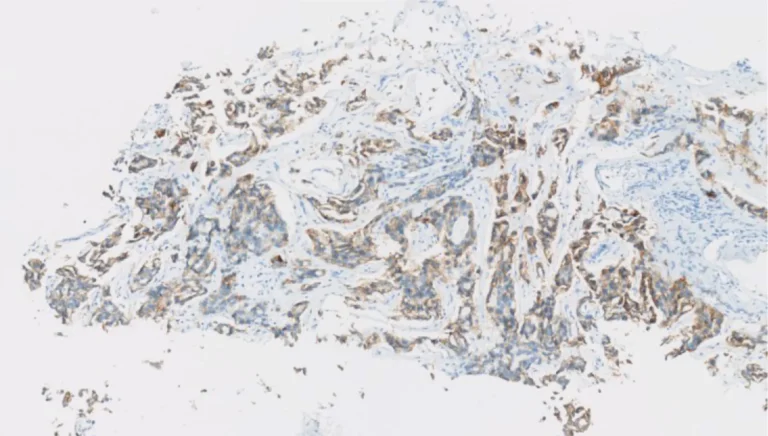
To identify these biomarkers, medical teams rely in particular on immunohistochemistry (a laboratory technique used to visualize specific proteins in tissue cells) and molecular biology, which analyzes the genetic or molecular characteristics of a tumor.
Pathologists must analyze samples that are sometimes very small, obtained from biopsies or cytological specimens, while preserving enough material to perform several tests. This task is becoming increasingly complex with the arrival of new targeted treatments, immunotherapy and now ADCs.
The article underlines the need to develop more effective strategies to organize these analyses, avoid exhausting tissue samples and provide reliable results within timeframes compatible with patient care.
Technical challenges in bringing innovation into daily practice
Integrating ADC-related biomarkers into routine clinical practice raises several challenges. The authors point in particular to sample variability, differences between staining methods, interpretation thresholds, analysis tools and quality requirements.
For example, the same biomarker may be assessed using different scores depending on the treatment being studied. This can make results harder to interpret and complicate communication between pathologists and oncologists.
To address these difficulties, the article emphasizes the importance of harmonized international recommendations, quality control procedures, validation networks between laboratories and stronger coordination between clinical, biological and pathology teams.
Artificial intelligence and integrative pathology as future drivers
The authors also highlight the potential of computational pathology, the analysis of medical images using digital tools and artificial intelligence, to improve biomarker assessment. These tools could help quantify the expression of certain proteins more accurately and reduce interpretation differences between laboratories.
The article also stresses the importance of integrative pathology, an approach that combines morphological, molecular, biological and digital results to gain a more complete understanding of a tumor. This broader vision is essential to support the development of precision medicine in lung cancer.
In the long term, the goal is clear: to better connect the characteristics of each tumor with the available treatment options, so that each patient can be directed toward the most appropriate therapy.
Expertise driven by IHU RespirERA
This work illustrates the expertise of the RespirERA Institute in thoracic oncology, biomarkers, molecular pathology and precision medicine. It is fully aligned with the Institute’s ambition: to accelerate the transfer of scientific advances into concrete applications for patients with respiratory diseases, including lung cancer.
By helping to structure knowledge on ADC biomarkers, the teams of the RespirERA Institute are contributing to a major international reflection on the future of lung cancer treatment.
Antibody-drug conjugates open new perspectives for patients with lung cancer. For these innovations to benefit as many people as possible, reliable biomarker identification, harmonized practices and equitable access to testing will be decisive steps.
Read the full article: New biomarkers for antibody-drug conjugates in lung cancer the pathologist’s perspective. Lung Cancer. 2026
 FR
FR  EN
EN 