
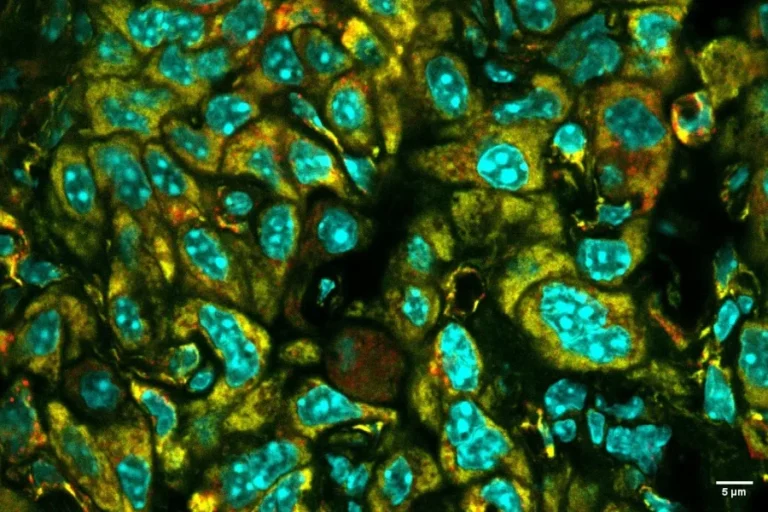
Teams from RespirERA Institute contributed to a study published on 16 October 2026 in Science Advances, revealing the role of mitochondrial recycling in lung cancer. In experimental models, disabling this mechanism enhances the effect of a treatment targeting KRAS.
A maintenance mechanism that cancer cells can exploit
Cells rely on their mitochondria (small structures that produce much of the energy they need) to function. When mitochondria become damaged, they can be removed through mitophagy (a process that selectively breaks down and recycles mitochondria).
This maintenance system helps keep cells functioning properly. However, it can also help cancer cells adapt to stressful conditions.
The researchers investigated a mitophagy pathway involving PINK1, a protein that helps identify damaged mitochondria. Their aim was to understand its role in lung tumour formation and the response to treatment.
A role from the earliest stages of tumour development
Analyses of human tissue revealed increased activation of this pathway in lung adenocarcinomas (a type of lung cancer). Experiments in mice then showed that mitochondrial recycling increases from the earliest stages of tumour development.
In the models studied, genetically disabling PINK1 limited the transformation of normal cells into cancer cells and reduced the development of tumour lesions.
Its role changes, however, as the disease progresses: once cancer cells are established, disabling PINK1 alone is no longer sufficient to slow tumour growth in the models tested.
A stronger response to treatment targeting KRAS
The scientists also investigated cancers associated with alterations in KRAS (a gene whose altered forms can promote uncontrolled cell growth). Targeted therapies, designed to act on specific abnormalities in cancer cells, can block certain forms of KRAS. However, tumours can use adaptive mechanisms that limit the effectiveness of these treatments.
In laboratory-grown cells and mice, the researchers found that disabling PINK1 enhances the effect of a treatment targeting KRAS. Cancer cells become more sensitive to treatment, and tumour growth is reduced more effectively.
These findings suggest that mitochondrial recycling helps tumour cells survive during treatment. Disrupting this mechanism could therefore provide a complementary strategy worth investigating.
Bringing together teams from RespirERA Institute
The study brings together several teams from RespirERA Institute. Led by Sandrine Marchetti and Jean-Ehrland Ricci, with Diogo Gonçalves as first author, it draws on the complementary expertise of the institute’s researchers. Co-authors include Guylène Rignol, Véronique Hofman, Professor Paul Hofman, Marin Truchi, Bernard Mari, Laurent Yvan-Charvet and Johanna Chiche.
These findings remain preclinical, meaning that the experiments assessing the effects of these interventions were conducted in the laboratory and in animals. They provide a basis for investigating new treatment combinations, whose effectiveness and safety will need to be evaluated in humans.
 Français
 English (UK)
