
An international meeting at the heart of respiratory health
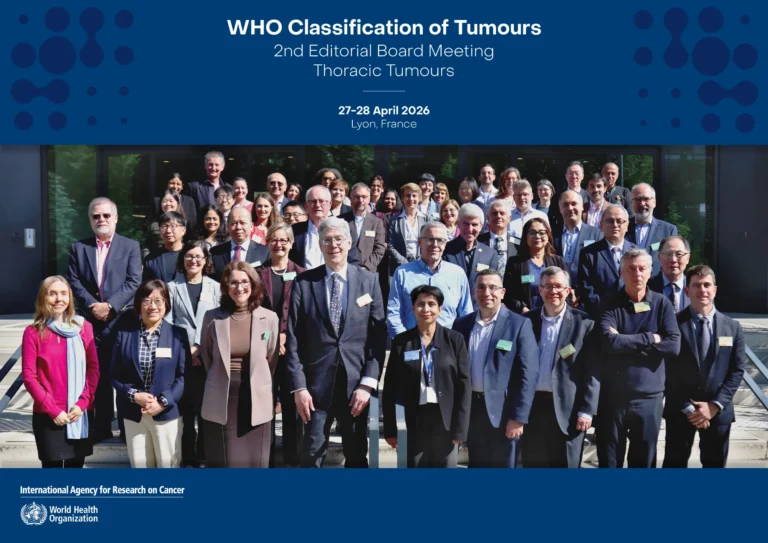
From 27 to 29 April 2026, a consortium of global lung cancer experts met at the headquarters of IARC (International Agency for Research on Cancer) in Lyon, under the aegis of WHO (World Health Organization).
The meeting brought together specialists from North America, South America, Asia, Europe and Australia. Their objective was to update the classification of lung cancers, which will soon be used worldwide.
This new classification aims to redefine the morphological and molecular bases of lung cancers. Morphological bases refer to the study of the appearance of cells and tissues under the microscope. Molecular bases relate to the analysis of the biological characteristics of tumour cells, particularly at the level of genes and proteins.
Improving diagnosis to better treat patients
Lung cancer remains the deadliest cancer worldwide. In light of rapid advances in research, it is essential to adapt diagnostic tools in order to improve patient care.
This new classification will make it possible to integrate the new entities that have emerged in the field of lung cancer over the past four years. It will serve as a reference work for pathologists and molecular biologists around the world.
Pathologists are medical specialists who analyse cells and tissues. Molecular biologists study biological mechanisms at the molecular level, such as DNA or proteins.
Professor Paul Hofman, the French representative within the consortium
Among the experts involved, France was represented by Professor Paul Hofman, Director of IHU RespirERA in Nice.
His mission within this international group was to create a new chapter dedicated to molecular markers predictive of response to personalised medicine therapies.
These molecular markers are biological characteristics observed in the tumour. They help physicians identify the most suitable treatments for each patient, according to the profile of their cancer. This is one of the major principles of personalised medicine: offering more targeted, more precise care that is better adapted to each patient.
A reference work to harmonise practices worldwide
This new global classification of lung cancers aims to harmonise diagnostic practices at the international level.
The objective is to enable healthcare professionals to rely on common criteria, regardless of the country in which they practise. This harmonisation is essential to strengthening equitable access to diagnosis and care for patients with lung cancer.
By taking part in this reference work, IHU RespirERA is contributing to the dissemination of the latest knowledge in respiratory health and to the improvement of medical practices for the benefit of patients.
This international meeting marks an important milestone in the evolution of lung cancer diagnosis. Professor Paul Hofman’s contribution to this new global classification highlights IHU RespirERA’s expertise in thoracic pathology and personalised medicine.
 Français
  English (UK)