
A study co-authored by two researchers affiliated with IHU RespirERA, Madalena Chaves and Jérémie Roux, offers new insight into why some cancer cells tolerate TRAIL, an immune system protein whose recombinant form, dulanermin, has been clinically evaluated as an anticancer agent. By combining single-cell observations with mathematical modeling, the scientists show that each cell’s response depends on its molecular state at the start of treatment.
Similar cells, different responses
When exposed to the same treatment, not all cancer cells respond in the same way. Some undergo apoptosis, a programmed process leading to their elimination, while others temporarily survive. These surviving cells are known as drug-tolerant persister cells.
Understanding the origin of this variability is an important challenge in cancer research. One question remains under debate: do these tolerant cells form a distinct subpopulation, or do they simply occupy a molecular state that makes them less sensitive when treatment begins?
A team comprising Giada Fiandaca, Marielle Péré, Kelian Bonhomme, Madalena Chaves and Jérémie Roux investigated this question in a study published on 13 July 2026 in npj Systems Biology and Applications.
Observing the initiation of cell death
The study draws on previously acquired experimental data from HeLa cells, a cell line derived from cervical cancer. These genetically identical cells had been exposed to three concentrations of TRAIL.
TRAIL is an immune system protein capable of activating receptors on the surface of cells and triggering a series of reactions that lead to apoptosis. The researchers monitored the activation of caspase-8, an enzyme involved at an early stage of this process, in individual cells. Measurements were obtained by microscopy using a fluorescent reporter every five minutes for up to twenty-four hours.
Using these experimental trajectories, the team developed a mechanistic mathematical model of the apoptosis pathway. The model notably incorporates procaspase-8, the precursor of caspase-8, and the protein c-FLIP, which can limit or modulate its activation.
A boundary between sensitivity and tolerance
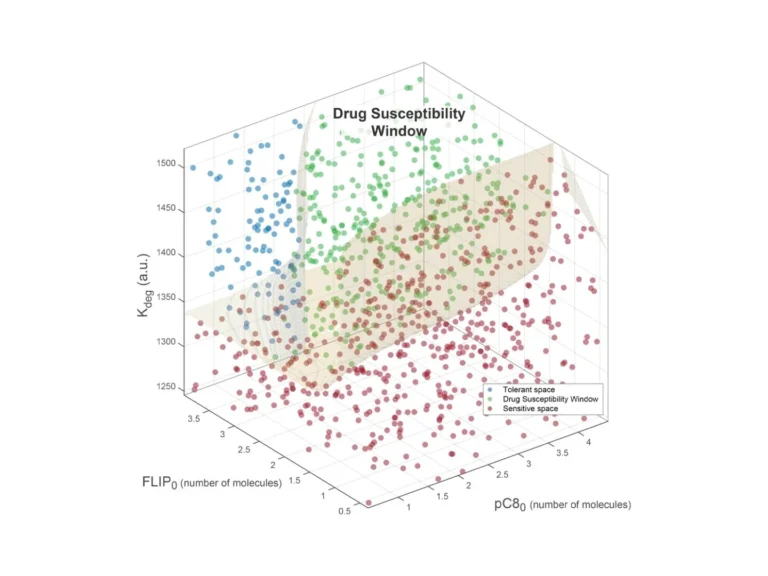
The results suggest that sensitive and tolerant cells do not necessarily correspond to two clearly separated biological groups. Instead, they appear to be distributed along a continuum of molecular states.
In this representation, each cell occupies a position determined notably by the estimated levels of procaspase-8 and c-FLIP, as well as the degradation rate of active caspase-8. Within the model, this position determines whether the cell crosses the threshold that commits it to apoptosis.
The model therefore reveals a “decision boundary” separating states associated with cell death from those associated with tolerance. As the TRAIL dose increases, this boundary shifts. Cells close to the boundary may become sensitive, while those located further inside the tolerant region retain their ability to survive.
A threshold defined using the response observed at the lowest dose enabled the model to closely reproduce the experimental proportions of sensitive cells at the two higher doses. However, this result was obtained within the same experimental framework and has not yet been validated in another biological model.
Better representing the diversity of cell states
This approach provides a mechanistic and quantitative explanation for fractional killing: within a population of clonal cells exposed to the same agent, only a proportion of the cells is eliminated.
Increasing the dose would not necessarily introduce a new biological mechanism. Instead, it would shift the boundary between sensitivity and tolerance within an already heterogeneous population. Persister cells could therefore arise from pre-existing, reversible molecular variations without requiring a specific genetic mutation.
The approach does more than predict which cells will die or survive. It provides a molecular map explaining why a cell is in a sensitive or tolerant state when treatment begins. This map also provides a framework for exploring new research strategies, such as moving cells away from regions associated with tolerance, shifting the decision boundary or targeting vulnerabilities specific to tolerant cells. These possibilities remain experimental and will need to be evaluated in other models before any therapeutic application can be considered.
Experimental findings requiring further confirmation
Several limitations must be considered when interpreting these findings. The study was conducted using a laboratory cell line rather than patients. It mainly examines the early stages of caspase-8 activation and does not reproduce all the biological pathways that may promote cell survival.
The relationship between procaspase-8 and c-FLIP levels is also inferred from model calibration. Its compatibility with public transcriptomic data was examined, but the levels of these two proteins were not measured directly in the same HeLa cells. Additional measurements and validation in other models will therefore be required.
A publication supported by RespirERA Institute
Madalena Chaves and Jérémie Roux, the corresponding authors of the publication, are affiliated with IHU RespirERA. Their contributions included the study’s conceptualization, methodology, software development, data analysis, project supervision and scientific writing.
The work also received support from the France 2030 program dedicated to IHU RespirERA. It illustrates how experimental biology and mathematical modeling can be combined to improve our understanding of the cellular mechanisms involved in treatment response.
 FR
FR  EN
EN 