
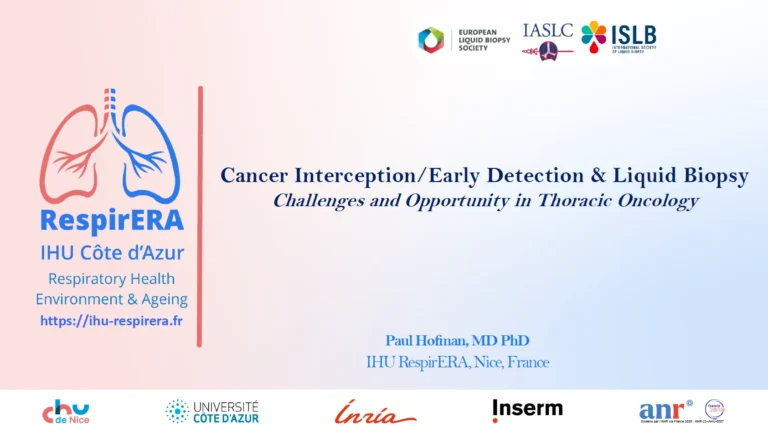
On 30 September 2026, Prof. Paul Hofman, Director of the RespirERA Institute, took part in an international webinar on liquid biopsy. His presentation explored the opportunities and challenges associated with this approach to detect lung cancer earlier and consider interventions before the disease develops further.
A webinar dedicated to sharing knowledge
Entitled “Liquid biopsy in lung cancer and other diseases: state of the art and perspectives”, the webinar brought together specialists to discuss the current applications and future prospects of liquid biopsy. Scientifically coordinated by Marcello Tiseo and Roberta Minari, it covered lung cancer as well as other cancers, including breast and colorectal cancer.
Prof. Paul Hofman contributed to the session on cancer detection, delivering a presentation on the challenges and opportunities of liquid biopsy for cancer interception.
Searching the blood for signs of cancer
The liquid biopsy (the analysis of a biological fluid, such as blood, to detect elements associated with a tumour) can be used to study different signals, including tumour cells, DNA fragments and certain molecules. These elements may provide information about the disease without the need to collect a tissue sample directly from the tumour.
During his presentation, Prof. Hofman explored several research avenues aimed at using these signals to detect lung cancer at an earlier stage. He also distinguished early detection, which seeks to identify cancer that is already present, from cancer interception (an approach aimed at acting during the earliest stages of cancer development, before the disease becomes clinically apparent).
Combining approaches and validating their reliability
The presentation highlighted the biological and technical challenges associated with this research, as well as the importance of validating test performance before considering their wider use.
One of the approaches discussed involves combining blood tests, medical imaging and clinical information with the support of artificial intelligence. The aim is to cross-reference these data to better identify high-risk situations and improve detection.
Through this presentation, Prof. Paul Hofman shared the approaches being explored by the RespirERA Institute to bring together biomarker research (the study of measurable biological indicators) and the early detection of lung cancer.
 Français
  English (UK)