
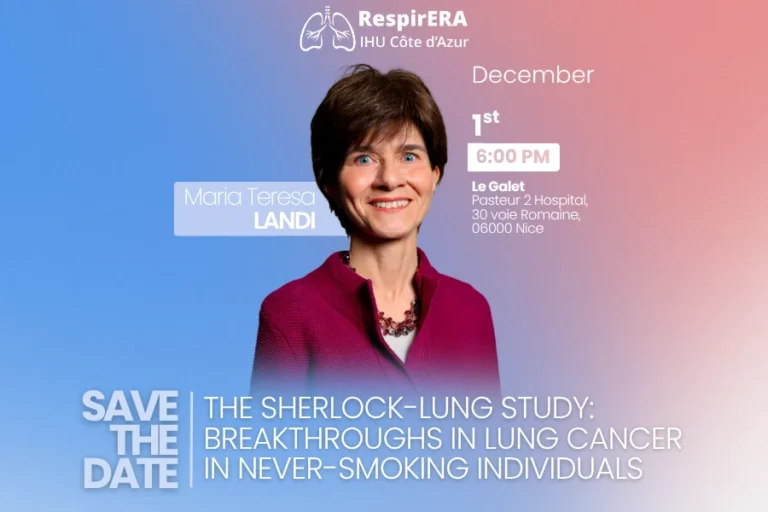
On 1 December 2026 at 6 pm, the RespirERA Institute will welcome Dr Maria Teresa Landi to the Le Galet auditorium, on the forecourt of Pasteur 2 Hospital in Nice. A researcher at the US National Cancer Institute, she will present Sherlock-Lung, a study investigating lung cancer in people who have never smoked. Free admission.
A researcher exploring the origins of cancer
A physician by training, Maria Teresa Landi studies the genetic and environmental factors involved in cancer development. She works at the National Cancer Institute (NCI) in the United States, where she is a Senior Investigator and Senior Advisor for Genomic Epidemiology (the study of how genetic characteristics influence the occurrence of diseases in populations).
Her research seeks to understand how tumours develop and evolve. To do this, she combines biological information from tumours with patients’ medical data and information about their environmental exposures. She leads Sherlock-Lung, an international study dedicated to lung cancer in people who have never smoked.
Understanding lung cancer in people who have never smoked
Although smoking remains the main risk factor for lung cancer, the disease also affects people who have never smoked. According to the NCI, these cancers account for approximately 10–25% of cases worldwide.
Certain exposures, such as air pollution, radon (a radioactive gas naturally present in the ground) and second-hand smoke, can contribute to the risk. However, the origins of a substantial proportion of these cancers remain poorly understood. Understanding the mechanisms involved is therefore an important research goal for improving prevention, detection and care.
Sherlock-Lung: looking for clues within tumours
Sherlock-Lung investigates this question by analysing DNA (the molecule that carries cells’ genetic information) from tumours and surrounding lung tissue. Researchers look for mutational signatures (patterns of DNA changes that can provide clues about the mechanisms that produced them).
These clues can help trace the history of tumours and identify the processes involved in their development. Another aim is to distinguish more precisely between different forms of lung cancer in people who have never smoked. In the longer term, this knowledge could help inform prevention and care strategies.
A conference exploring advances from Sherlock-Lung
Entitled “The Sherlock-Lung Study: Breakthroughs in Lung Cancer in Never-Smoking Individuals”, Maria Teresa Landi’s conference will explore advances from the study and our understanding of these cancers.
Hosted by the RespirERA Institute, this event offers an opportunity to discover the questions guiding this research, with the scientist leading Sherlock-Lung.
Join us on Tuesday 1 December 2026 at 6 pm at the Le Galet auditorium.
 Français
 English (UK)
