
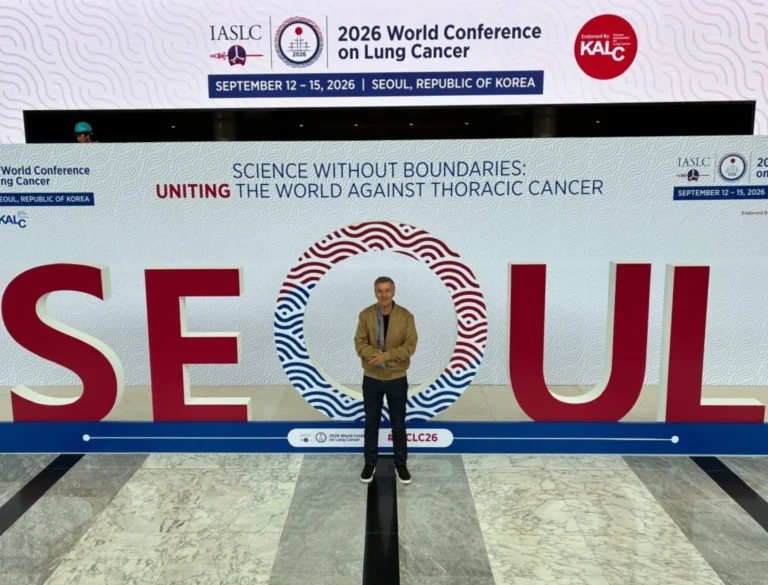
Professor Paul Hofman, Director of RespirERA Institute, contributed to an international collaborative study aimed at improving the diagnosis of pulmonary adenocarcinomas. The findings were presented at the 2026 World Conference on Lung Cancer, held in Seoul from September 12 to 15.
Titled The modified classification of pulmonary adenocarcinomas shows compared to the WHO classification improved reproducibility, the study focused on a crucial step in the diagnostic process: assessing whether a tumour is invasive. This evaluation helps pathologists distinguish adenocarcinoma in situ, which is considered non-invasive, from tumours that have begun to invade the surrounding tissue.
However, some microscopic features can be difficult to interpret, leading to differences in assessment between pathologists. To address this issue, the researchers compared the current World Health Organization (WHO) classification with a modified approach based on more detailed assessment criteria.
A total of 43 pathologists specialising in lung cancer took part in the study. They analysed digital images from 60 surgically resected pulmonary adenocarcinomas measuring three centimetres or less.
The results showed that the modified classification improved agreement between specialists. It enabled more pathologists to correctly identify non-invasive tumours while reducing variability in the measurement of their invasive component. These findings could help improve the accuracy and reliability of pulmonary adenocarcinoma diagnosis.
Nevertheless, the study also highlighted persistent challenges, particularly in distinguishing adenocarcinoma in situ from tumours displaying lepidic growth. The authors therefore recommend continued training for pathologists, as well as further improvements to classification systems and assessment methods.
Professor Paul Hofman’s contribution to this international collaboration reflects RespirERA’s commitment to advancing the accuracy of lung cancer diagnosis.
 Français
  English (UK)