

Pr Paul Hofman
Advice from Prof. Paul Hofman General Director of the RespirERA Institute
"Shortness of breath is part and parcel of exercise. What’s important is to learn to recognise your normal breathing pattern, to ensure you build up gradually during training sessions, and not to dismiss unusual breathing difficulties or an unusually long recovery time after exercise. Good preparation also means listening to your body and your breathing."
A marathon isn’t just about your legs, it’s also about your breathing

When you’re training for a marathon, you naturally think about kilometres, long runs, running shoes, strength training and nutrition. Yet there’s one thing that accompanies every stride, from the first to the last kilometre: your breathing.

Breathing is often seen as simply a consequence of exertion. You run, so you breathe faster and more heavily. But for a runner, it’s much more than that! It’s an indicator of pace, a tool for regulating effort, a measure of comfort and a warning sign when exertion is becoming uncontrolled.

With just a few months to go until the Alpes-Maritimes Nice-Cannes Marathon, the RespirERA Institute has produced a simple guide to help runners better understand their breathing and incorporate it into their training.

Understand

Why do we get out of breath when we run?

Shortness of breath is a normal bodily reaction to physical exertion. When you run, your muscles work harder. To produce the energy they need, they require more oxygen and produce more carbon dioxide, a gas that the body must eliminate.

Breathing therefore speeds up to meet this dual need: to take in more oxygen and expel more carbon dioxide.

The more intense the exertion, the greater this demand becomes. The heart beats faster to pump oxygen to the muscles, and the lungs work harder to keep up. It is this mechanism that causes the sensation of breathlessness.

In an endurance race such as a marathon, the aim is therefore not to avoid getting out of breath altogether. Rather, the aim is to maintain a controlled, steady breathing pattern that is sustainable for the duration of the effort.

GOOD NEWS

With training, your breathing becomes more efficient. Your heart, muscles and breathing gradually learn to work better together. At the same pace, the effort may then feel easier, your breathing more steady and your recovery quicker. That is why breathing is something you work on over time: session after session, your body adapts.

Impact

Is breathing important when you’re running?

During exercise, the muscles need more oxygen to function. Breathing therefore naturally speeds up to meet this demand. Feeling out of breath during a run or a training session is normal: it’s a sign that the body is adapting to the intensity.

But when your breathing becomes too difficult to control, it can quickly affect your performance.

Poor breathing control can lead to:

  • a greater sense of exertion
  • a struggle to keep up the pace
  • fatigue that sets in earlier
  • a more difficult recovery between periods of exertion
  • a loss of comfort, particularly on long rides
  • a feeling of ‘enduring’ the race rather than managing it

Conversely, learning to listen more closely to your breathing often helps you pace yourself better, run at a more steady pace and avoid setting off too quickly.

KEY POINTS

Controlled breathing isn’t everything, but it does help you perform at your best.

Advantages

A real boost to your performance

Managing your breathing effectively does not magically transform a runner’s performance level, but it can make a real difference to how you experience the effort. With regular training, your breathing often becomes more steady at the same pace, you feel better, and what seemed difficult at first can become more comfortable as the weeks go by: your body adapts, your endurance improves, and you gradually gain better control over the effort.

A more consistent pace

Your breathing helps you recognise when the intensity becomes too high. It therefore enables you to adjust your pace more quickly before you become too tired.

Greater comfort during exercise

Smoother breathing, combined with a relaxed posture, can make running more enjoyable, particularly on long runs.

Better energy management

By avoiding starting too quickly and accelerating without proper control, the runner conserves more energy for the rest of the race.

An easier recovery

Knowing how to slow down, release tension and breathe more calmly can help you recover better after a climb, a sprint or a difficult section.

Listening more closely to your body

Breathing is a valuable indicator. It helps to distinguish between normal exertion and unusual discomfort that warrants attention.

Landmark

Your breathing: your best indicator of pace

One of the most common mistakes in running is setting off too quickly. At first, your legs feel good, the atmosphere is motivating, and the pace seems comfortable. Then, gradually, your breathing becomes laboured, you start to feel worse, and the effort becomes harder to sustain.

Breathing can actually help you avoid this pitfall.

The talk test

Can you still speak?

Whilst you’re out running, you should generally be able to speak in short sentences.

If you can no longer speak for a few moments without having to catch your breath, it is often because the intensity is too high for a prolonged effort.

This tip is simple, but very useful:

You can speak easily

A comfortable pace, probably suitable for an endurance ride.

You speak in short sentences

A sustained effort, but still under control.

You can no longer speak

High intensity, difficult to sustain for long.

When preparing for a marathon, this test can be an excellent tool. It helps you stay within an intensity range suitable for the duration of the race, particularly during long runs.

A practical guide

Learning to breathe better

01

Start your sessions gradually

Your breathing needs time to adjust. Starting too quickly forces your body to react abruptly: your heart rate rises rapidly and your breathing quickens. This can make the first few minutes uncomfortable and may even affect the rest of your run.

Before a session, start with a few minutes at an easy pace. The aim is not to save time, but to allow your body to ease into the exercise gradually.

The right habit

The first 10 minutes should be deliberately easy. If you feel you could go faster, that’s probably a good sign: keep that energy in reserve.

02

Use your breathing to control your pace

In a marathon, the aim isn’t just to run fast. Above all, it’s to keep running for a long time. Your breathing can help you maintain that steady pace.

If you find yourself getting out of breath very quickly right at the start of a long run, it may be that you’re running too fast. Conversely, a more steady breathing pattern often indicates that you’re managing the effort better.

The right habit

During your training sessions, ask yourself regularly: ‘Am I still in control of my breathing, or am I letting it get the better of me?’ This simple question can help you avoid many pace-related mistakes.

03

Don’t worry about breathing perfectly

We often hear that we should breathe solely through the nose, or follow a specific rhythm such as ‘two steps to breathe in, two steps to breathe out’. In reality, there is no single way of breathing that suits all runners in all situations.

At low intensity, some runners breathe naturally through their nose. As soon as the effort increases, breathing through the mouth as well becomes normal, as the body needs to take in more air.

The key, therefore, is not to force a particular technique. The aim is rather to find your own breathing pattern: smooth, comfortable and suited to the intensity of the effort.

The right habit

Don’t hold your breath. Try to breathe smoothly, naturally and steadily.

04

Remember to breathe out

When exercise becomes strenuous, we often think of "taking a breath". But exhaling is just as important. If you exhale too briefly or too tensely, it can make your breathing feel shallow and strained, and therefore less comfortable.

During easier phases or moments of recovery, breathing out a little more slowly can help you regain your composure and release tension.

A simple exercise to try out in training

Sur une portion calme, inspirez naturellement, puis essayez d’expirer un peu plus longuement pendant quelques cycles respiratoires. Le but n’est pas de forcer, mais de retrouver une respiration plus posée.

05

Relax your upper body

Breathing does not depend solely on the lungs. Posture, the shoulders, the arms and tension in the upper body can all affect how comfortably you breathe.

A more relaxed body makes breathing more comfortable.

Tense shoulders, arms held too high or a clenched jaw can make the effort feel harder. Over long distances, these small tensions can build up.

The right habit

During your walks, regularly give your upper body a quick "scan":

  • Shoulders down
  • Arms relaxed
  • Supple hands
  • Relaxed jaw
  • Look far ahead
The race

3 key moments when a breath can change everything

At the start

The start is a risky moment. The energy of the group, the music, the atmosphere and the desire to do well can cause you to speed up without realising it.

However, setting off too quickly can prove costly later on. If you’re already finding it hard to breathe in the first few kilometres, this is often a sign that your pace may be too ambitious.

Objective

Start off with controlled breathing: it feels almost too easy at first.

During climbs or accelerations

Even a slight incline can significantly increase the intensity of the effort. Trying to maintain exactly the same pace can cause you to become breathless.

At times like these, it’s best to accept that you need to adjust your pace. Slowing down slightly can help you stay in control and avoid using up too much energy.

Objective

Manage the intensity rather than defending the pace at all costs.

In the final kilometres

When fatigue sets in, your breathing may become shallower, higher-pitched and more irregular. It is often at this point that your mind starts to take over.

Getting back in touch with your breathing can help you refocus: a breath in, a breath out, a few strides...

Objective

Use your breathing as a simple guide to stay on track.

When should you be on your guard?

It is normal to feel out of breath during exercise. However, certain signs should not be ignored.

It is best to slow down, stop exercising and seek medical advice if you experience:

  • sudden or unusual shortness of breath
  • chest pain or tightness
  • feeling unwell, dizzy or very weak
  • unusual wheezing
  • a persistent or troublesome cough on exertion
  • difficulty recovering long after stopping

Representation of cancer cells distributed between a TRAIL-sensitive zone and a TRAIL-tolerant zone.
Publication
A model sheds light on why some cancer cells tolerate an immune system protein investigated for its anticancer potential
A study co-authored by two researchers affiliated with RespirERA Institute models the molecular states that may influence cancer cell tolerance to TRAIL.
Rise For Healthy Aging - longevity lndia Conference 2nd Edition
Congress
Ageing and lung cancer: RespirERA at RISE 2026
Professor Paul Hofman will present several IHU RespirERA research projects on lung ageing, senescence and lung cancer in older adults at an international conference in India.
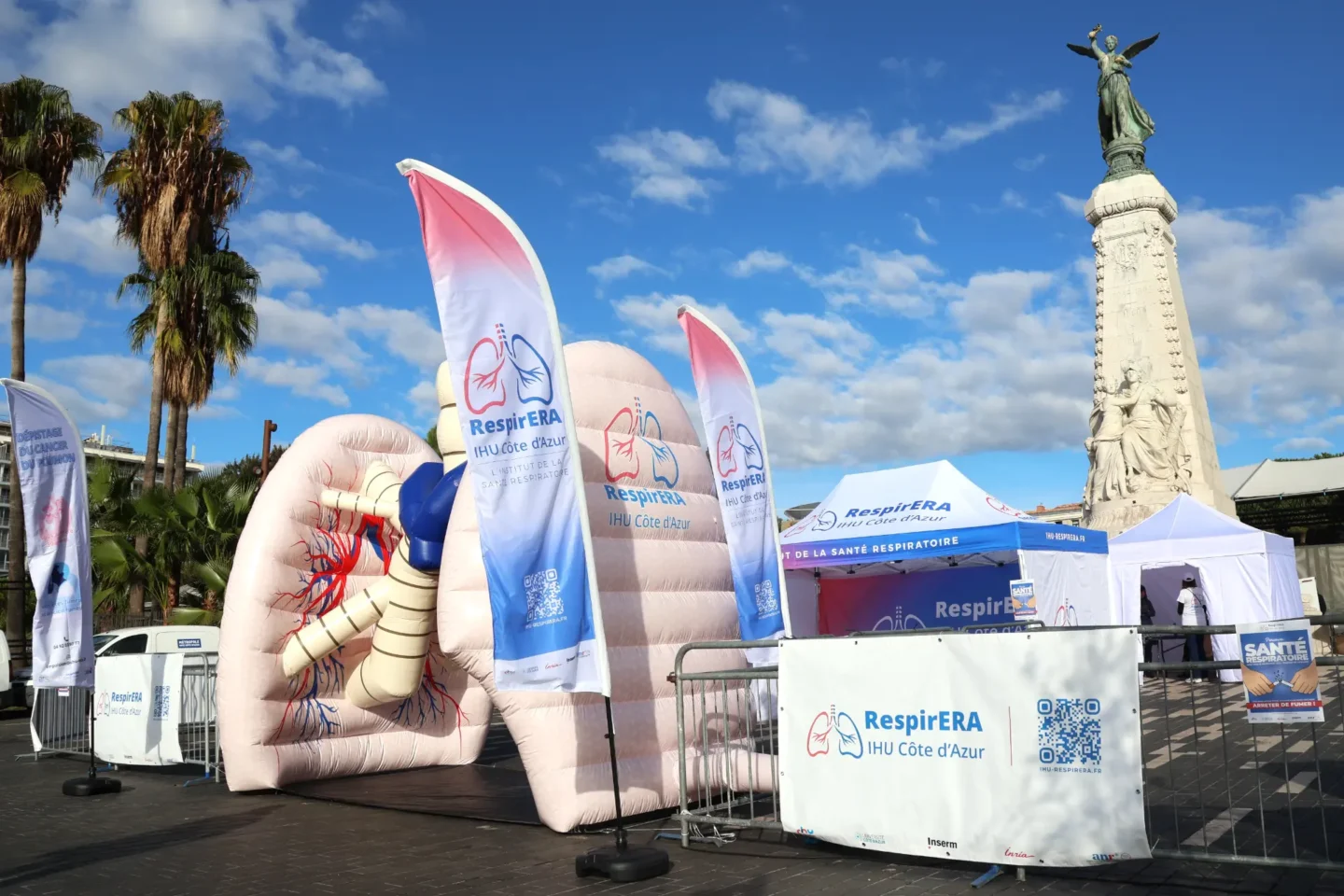
Giant lung installed in Nice to raise awareness of smoking and respiratory diseases.
Events
Mois Sans Tabac 2026: RespirERA Institute Organises a Respiratory Health Event in Nice
11/04/2026
On 4 November 2026, IHU RespirERA will hold a free public event in Nice focusing on smoking prevention, respiratory health and screening.
European Coalition for Access to Comprehensive Genomic Profiling (ECGP)
Featured
Paul Hofman joins European coalition to promote equitable access to broad gene panel testing in oncology
Paul Hofman joins the ECGP Steering Group to contribute to European discussions on equitable access to broad gene panel testing in oncology.
News
Smoking and cancer: discovery of a new genetic signature
A major international study has just revealed a new genetic signature associated with smoking across several types of tumors. Professor Paul Hofman, Director of the RespirERA Institute, discusses the insights gained from this discovery and the perspectives it opens up for research.
The RespirERA Institute is taking part in PADDEL, a project exploring links between emerging pollutants, the environment and lung cancer.
Featured
PADDEL Project: Better Understanding the Impact of Emerging Pollutants on Lung Cancer
The RespirERA Institute is taking part in the national PADDEL project, which will analyse links between emerging pollutants and lung cancer by combining medical and environmental data.
The RespirERA Institute acquires the NovaSeq X to accelerate genomic and multi-omics research on respiratory diseases.
Featured
The RespirERA Institute strengthens its research capabilities with the acquisition of the NovaSeq X
With the acquisition of the NovaSeq X, the RespirERA Institute strengthens its genomics platform to accelerate the analysis of respiratory diseases and support the development of more personalised medicine.
The RespirERA Institute is participating in the SOPHiA GENETICS Innovation Summit 2026, dedicated to innovations in precision medicine, biomarkers, and artificial intelligence.
News
Liquid biopsy and precision medicine: the challenges of large-scale deployment
Professor Paul Hofman, Director of the RespirERA Institute, took part in the SOPHiA GENETICS Innovation Summit 2026, an international event dedicated to innovations in precision medicine. This event...
A review published in Lung Cancer highlights the role of biomarkers in guiding the use of new targeted treatments for lung cancer.
Publication
Lung cancer: better identifying patients who may benefit from new targeted treatments
RespirERA Institute experts review biomarkers guiding new targeted treatments in lung cancer.
A study involving the RespirERA Institute helps improve the selection of targets for cancer immunotherapy.
Publication
Cancer immunotherapy: a study involving the RespirERA Institute opens new perspectives to better select therapeutic targets
A study involving the RespirERA Institute highlights the importance of shared epitopes to better select targets for future cancer immunotherapies.